
Survey Results on Italian Plurals
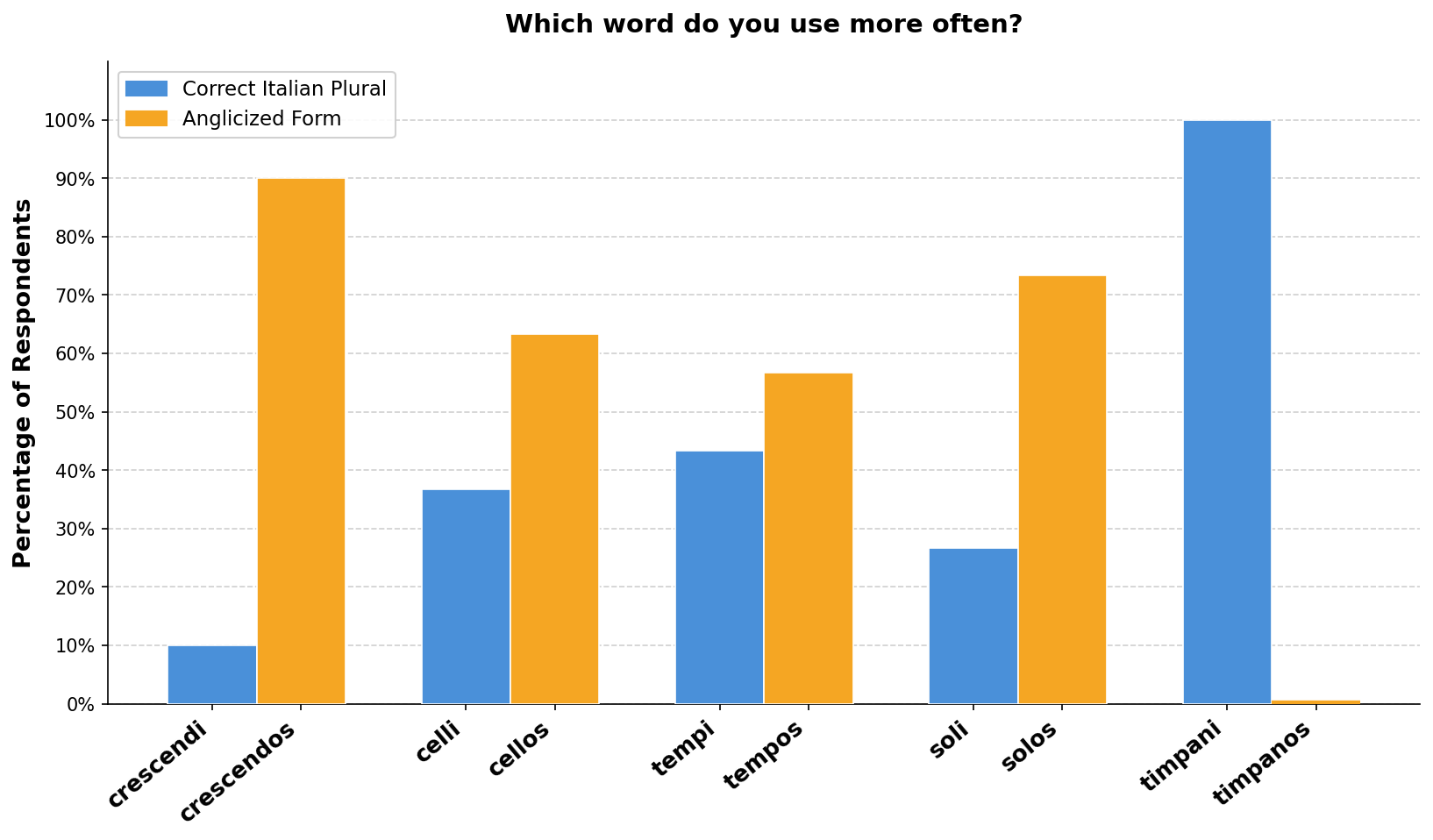
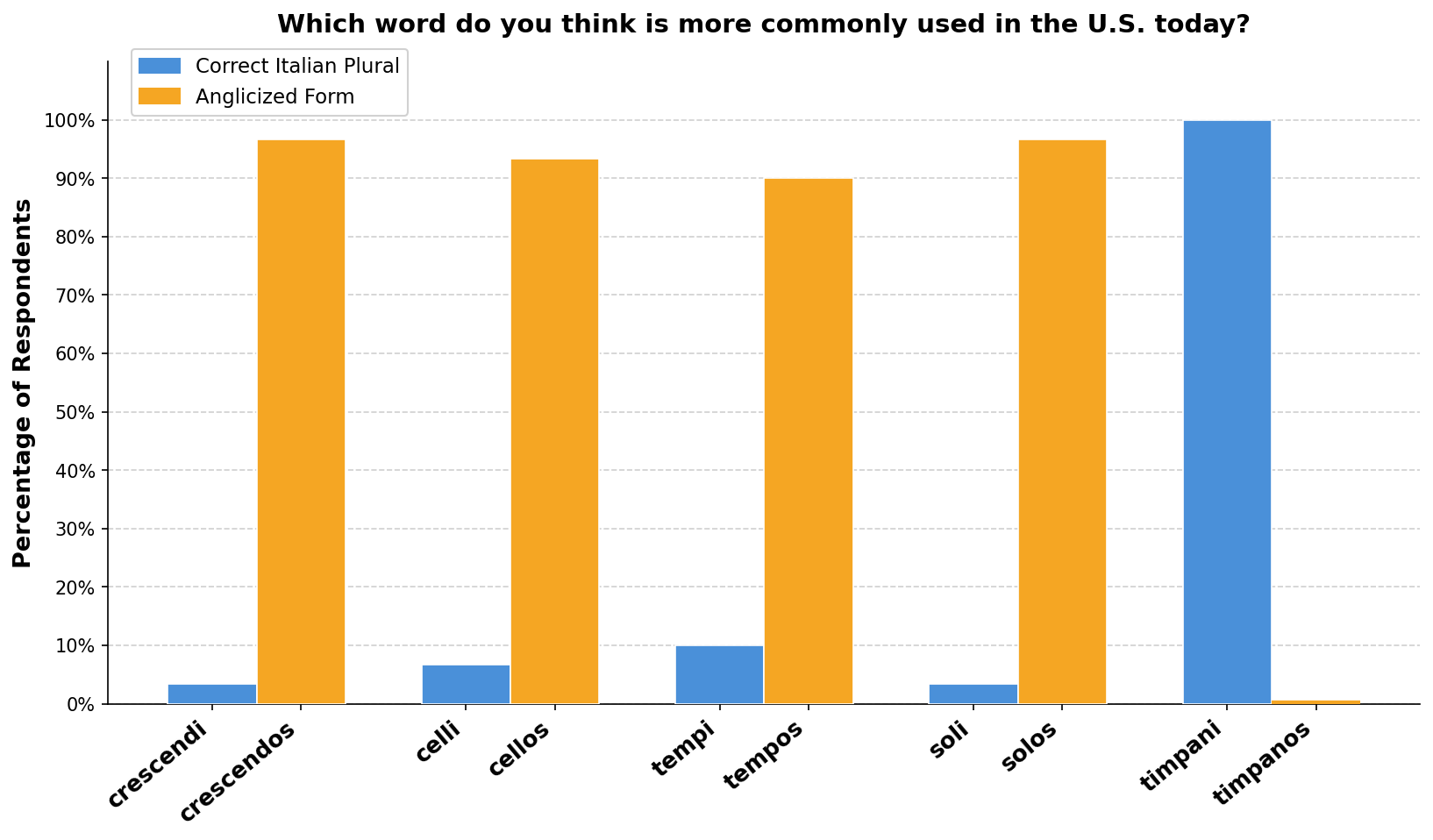
Participants were asked whether they use the correct Italian word for common musical terms in their plural form, or if they use the anglicized version. For example, do you say “tempi” or “tempos?” Most respondents use the anglicized version of these words (tempos, cellos, crescendos), with the exception of “timpani…” No one is saying timpanos!
Here’s what our survey participants had to say about their use of musical terms in their plural form, and their opinion of how common it is for others to use them.
Now how should we be spelling these questionable words, anyway? In English, when an “o” at the end of a word is preceded by a consonant, we generally add “es” to form the plural, as in potatoes, echoes, heroes, or dominoes. This begs the question, should I be spelling the anglicized plural of crescendo as “crescendos” or “crescendoes?”
It is normally spelled “crescendos,” and the explanation is based on the word being borrowed from a foreign language. Yet it is not technically borrowed from Italian, which would reject both options in favor of “crescendi!”
So if you are inclined to be a purist, you are correct but outnumbered, and if you go with the majority opinion, you may get some scowls from your erudite academician friends. Regardless, be prepared to be chastised by spell check!
All humor aside, it is useful to know the Italian plural forms to understand some common musical terms. For example, we often encounter “solo” and “soli” in orchestral music. An awareness that the “i” ending makes it plural clarifies that a single player performs the melody line for a solo, while multiple people are playing the melody line for a soli.
Now for the million dollar question… were our survey participants correct? Let’s see how they did! Those who chose the blue “Correct Italian Plural” below were in fact correct. Yes, some people thought “timpanos” is correct, but no shame here! We’re safe, only the percussionists will be offended.

We received some great feedback from music teachers who participated in the survey!
“Having studied Italian in college, I know the correct Italian plurals (including viole for viola) but feel that using them sounds rather stilted. I have a student for whom Italian and German are his first languages (and we conduct our lessons in English). Even with him I’m going to use English plural construction for Italian terms. It’s interesting to me that I will hear myself and others use celli (I also say cellos) but never hear violini or viole and only occasionally hear bassi (and this almost always when referring to a unison cello/bass part). As I’m considering this subject, I realize there are a few other Italian plurals I’m likely to use: staccati (but not marcati/legati/tenuti), concerti (but not sonate/cantate/partite) and possibly one or two more.”
- Mark Pfannschmidt, Private Violin, Viola, Piano, Music Theory, and Harp Teacher
“I taught a middle school cello sectional once in which I explained the singular “o”/plural “i” difference because I had referred to the group as “celli” and they expressed some confusion. I seized the teachable moment. As we prepared to continue our work, one student suddenly exclaimed, “Wait! Does that mean one noodle is a spaghetto?” I still chuckle about that to this day! I congratulated them on their understanding of the subject and told them their logic was sound in the assumption (but since I had never had to refer to just one noodle, I didn’t know!). It was a great moment.”
- Katie, Private Cello Teacher and Freelancer